


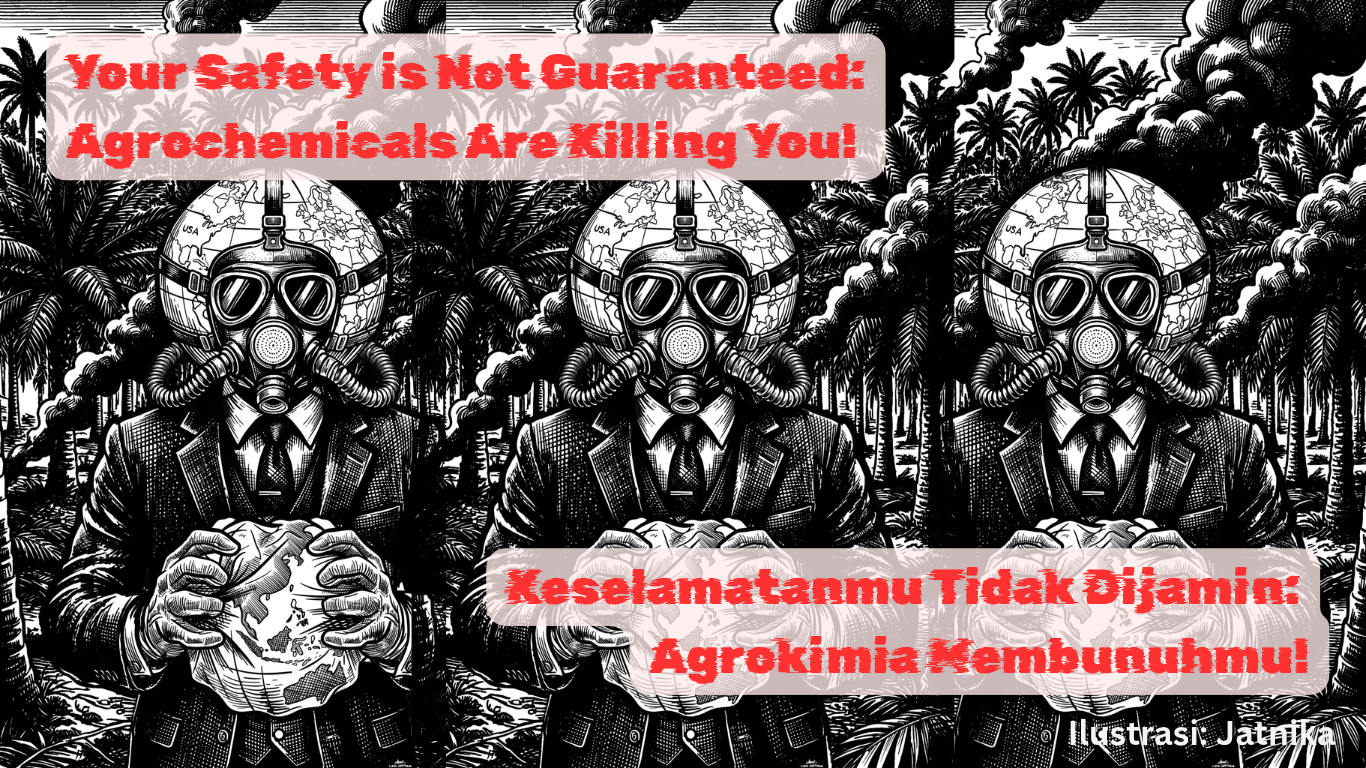
Basically, pesticides and chemical fertilizers contain active ingredients known for their toxicity to humans, animals, and the environment. The World Health Organization (WHO) has attached a classification list of active pesticide ingredients based on the level of acute toxicity, or adverse effects that arise immediately after short-term exposure.
___
Behind the global agrochemical product distribution chain, a number of giant companies control the majority of the agrochemical product business. The ETC Group and GRAIN report titled Top 10 Agribusiness Giants shows that Syngenta Group, Bayer, BASF, and Corteva are four agrochemical giant companies that controlled 61 percent of the pesticide market based on 2023 sales flows.
In addition to dominating the pesticide market, these four giant companies also hold a strong position in the global commercial seed market. The same report also shows control of about 56 percent of the global commercial seed market, with Bayer alone controlling about 23 percent.
The insane scale of profits of these agrochemical giants shows how massive the business interests are behind the agrochemical industry.
In its 2025 financial report, Syngenta Crop Protection, a subsidiary of Syngenta Group, recorded sales of US$13.7 billion or equivalent to Rp245.56 trillion at the current exchange rate. Corteva Crop Protection posted around US$7.5 billion or equivalent to Rp134.44 trillion.
In addition, Bayer reported sales for its Crop Science division of €21.6 billion or equivalent to Rp439.99 trillion, which includes seeds as well as crop protection products. Meanwhile, BASF recorded sales for its Agricultural Solutions segment of €9.6 billion or equivalent to Rp198.8 trillion.
These sales records include agrochemical products ranging from fungicides, herbicides, and insecticides, to seeds. These figures show that agrochemicals are the pillar of economic strength in the industrial-scale food system.
The market dominance by these giant agrochemical companies goes hand in hand with global health and environmental scandals. Bayer, for example, is facing legal cases related to glyphosate-based products formerly owned by the US-based company, Monsanto, which it acquired in 2018.
In its annual report, Bayer noted that the company allocated special funds and liabilities related to the glyphosate cases reaching US$11.3 billion or equivalent to Rp202.48 trillion, even though the company continues to deny the safety risks of its glyphosate products.
The Office of the UN High Commissioner for Human Rights reported that agrochemical products, especially pesticides, are closely linked to various health risks such as poisoning and a number of chronic diseases.
The UN also highlighted the export practices by agrochemical giant companies concentrated in the Global North. They continue to export pesticides to countries in the Global South even though the products are banned in their countries of origin.
According to the UN report, European Union countries in 2018 exported more than 81,000 tons of pesticides containing banned chemicals.
Thus, the global agrochemical issue is closely related to the concentration of power among giant agrochemical companies, control over the food production system, and the inequality of health protection between the Global North and the Global South.
This also shows how profits are concentrated in one hemisphere while the risks accompanying the adverse impacts of agrochemicals are diverted to the other hemisphere.
Types of Agrochemicals Banned in the Global North
Amid growing attention to the risks of agrochemical exposure to health and global ecosystems, various state authorities have taken decisive steps by banning the use of a number of toxic agrochemicals in their territories.
The European Union officially banned the circulation of pesticides through Regulation (EC) No.1107/2009. This regulation prohibits the circulation of pesticide products proven to damage human health and ecosystems.
One of the widely banned toxic chemicals is the herbicide paraquat. This chemical has been banned in more than 70 countries, and has specifically been banned in the European Union since 2007 due to its strong correlation with the risk of Parkinson’s disease suffered as a result of exposure to paraquat chemicals.
Another herbicide, diquat, is also no longer allowed to circulate, especially in the European Union in 2018 through Regulation (EU) 2018/1532. Exposure to diquat has been proven to have high levels of exposure-related damage in humans, ranging from nerve tremors and temporary muscle paralysis, to the risk of eye damage and blindness.
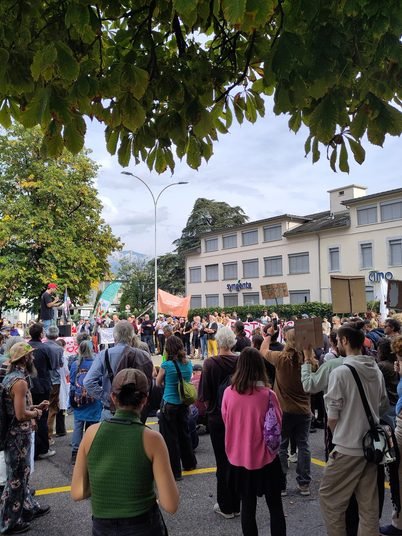
A number of protesters gathered in front of the Syngenta office building, France (10/3/2026). Source: Special
In addition to these two deadly toxic agrochemicals, many countries have also banned the circulation of other toxic agrochemicals such as dichloropropene and the herbicide atrazine. The ban on the circulation of both is related to the risk of hormonal system damage, triggering cancer risks, and the risk of water source quality pollution.
Unfortunately, while a number of these agrochemicals have been banned or restricted in various countries, primarily in the Global North, the exact same substances are documented as being used in palm oil plantations in Indonesia.
A study by Pesticide Action Network (PAN) Asia Pacific and OPPUK in North Sumatra (2018) showed the use of the Gramoxone trademark containing paraquat in two plantation companies. Furthermore, the report also noted that many workers did not know the types of pesticides being used.
This issue is further exacerbated by the lack of information regarding the chemicals used by the workers. In the same report, it was found that there were three companies mixing pesticides for spray workers using unlabelled jerry cans.
Consequently, according to the report, the spray workers, who are predominantly female, did not know the types of pesticides they used along with the impacts of their exposure.
The Dangers of Agrochemical Use
In the monoculture industry, one of the deadly dangers lurking for workers stems from the use of agrochemicals applied every year.
Agrochemicals are all types of chemicals used in plantations to assist plant growth, including pesticides, chemical fertilizers, and plant growth regulators.
Pesticides and chemical fertilizers are the most frequently used chemicals because they play an important role in controlling pests, insects, weeds, and providing additional nutrients. According to the Ministry of Agriculture records as of September 30, 2026, there are 7,723 pesticides registered in Indonesia.
Paraquat is a class II or moderately hazardous active ingredient. In line with this, Maksuk (2019) reported that paraquat exposure not only causes health problems but can also lead to death, with a mortality rate of around 70-80 percent.
This is because paraquat can damage the liver, heart, kidneys, and other organs through respiration, the mouth, and skin pores. To date, there is no medical treatment that can cure paraquat exposure in humans.
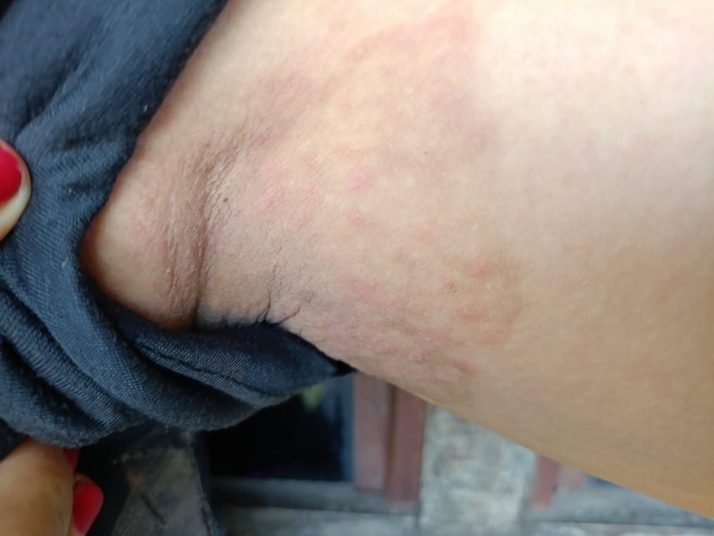
One of the palm oil workers experiencing skin rashes due to pesticide exposure. Source: Special
Since 2011, the Chemical Review Committee (CRC) itself has proposed paraquat, both pure and in its derivative formulas, to be subject to the Prior Informed Consent (PIC) procedure.
This is a procedure to ensure that importing countries receive complete information before banning, permitting, or setting conditions on the import of hazardous chemicals.
This aims to hold exporting and importing countries responsible for preventing environmental damage and human health issues caused by chemical trade.
To date, out of the 38 list of pesticides ratified by the Rotterdam Convention to be subject to PIC, paraquat still holds the status of a proposed chemical.
In practice, the active ingredient paraquat is still used in Indonesia, including in the monoculture palm oil industry. This ingredient manifests in products called Gramoxone, Noxone, and Supremo.
Gramoxone itself is produced by Syngenta, Noxone by PT Multi Sarana Indotani, and Supremo by PT Dharma Guna Wibawa.
Working Conditions of Palm Oil Workers
Oktriyedi and Lela (2025) reported that occupational accident cases in palm oil plantations reached 224,000, with the majority being eye and leg injuries. This condition occurs due to the limited availability of Personal Protective Equipment (PPE), distant work locations from medical centers, and a lack of Occupational Health and Safety (OHS) training and supervision.
Regarding PPE, companies are obligated to provide it for free, periodically, and balanced with PPE quality monitoring. This is because long-term exposure to chemicals, no matter how small, carries a risk of death. The absence of OHS officers in field monitoring further exacerbates this condition.
The issue of health facilities is also something that companies must pay attention to. The provision of vitamins and Medical Check-Ups (MCU) needs to be done periodically to maintain and monitor the workers’ health conditions.
In addition, companies are also obligated to provide sanitation facilities. These facilities serve as a place to clean up residual chemical exposure from the workplace. The availability of these facilities is also useful for menstruating female workers so they do not have to endure using sanitary pads for up to 8 working hours.
Even so, the availability of PPE, health facilities, and sanitation facilities are mere administrative controls that are inherently ineffective.
In the OHS management system, the most effective priority step for controlling chemical hazards is the action of eliminating or stopping the use of hazardous materials used in the work environment.
However, this does not happen in the palm oil plantation industry. Workers employed in spraying and fertilizing have a high risk of exposure to toxic chemicals because they have to make contact with them every day. This aligns with Maksuk’s (2019) findings regarding the presence of paraquat residues with the highest concentration in the urine of female palm oil workers.
Residues from chemical exposure in the workplace can also be brought home and spread to family members. This can happen due to the lack of clean water sources at the workplace for decontamination from chemical exposure.
This poor work environment is further reinforced by a worker system that is no work no pay. They have to work under high target demands with wage calculations based on piece rates and time rates. Therefore, workers often lack clear employment agreements and social security from the company.
National and International Policies Regarding Agrochemicals
Indonesia strictly regulates pesticide registration through the Ministry of Agriculture Regulation (Permentan) Number 43 of 2019 concerning Pesticide Registration. The regulation specifically covers chemical licensing and the obligation to provide hazard warning labels.
In this regard, paraquat dichloride, a derivative formula of pure paraquat, is classified as a Restricted Pesticide. This is contained in Appendix III table A of Active Pesticide Ingredients Designated as Restricted Pesticides.
Furthermore, in Article 13 paragraph (2), an active ingredient can be classified as a Restricted Pesticide if one of its impacts causes chronic, subchronic, or delayed poisoning to humans when used singly or in compounds.
Simply put, an active ingredient that causes poisoning in the long term (chronic), medium term (subchronic) due to repeated exposure, or a single exposure (delayed), is classified as a Restricted Pesticide. This hazard applies both when the pesticide is used alone or when mixed with other types of pesticides.
Permentan Number 43 of 2019 also asserts the obligation for distribution license holders to facilitate and conduct safety training for users of Restricted Pesticides. This is stated in Chapter X Article 93 paragraphs (1) to (5) and Article 94 paragraphs (1) to (2).
Provisions regarding the provision of facilities, safety training, and health reporting for pesticide users are also regulated in the Minister of Manpower Regulation (Permenaker) Number 3 of 1986 concerning Occupational Safety and Health Requirements in Workplaces that Manage Pesticides.
For example, in Article 15, it is written that employers must provide hygiene facilities to wash and care for work equipment, provide bathing places, water, and soap, provide food and drink facilities that are safe from pesticides, and create emergency response procedures and units.
On the international stage, the use of active pesticide ingredients is subject to the PIC mechanism ratified in the Rotterdam Convention. There is also the 1981 International Labour Organization (ILO) Convention Number 155 which serves as the OHS reference. In the European Union itself, the ban on pesticide circulation is contained in Regulation (EC) No.1107/2009 and Regulation (EU) 2018/1532.
In reality, various regulations in Indonesia regarding pesticide use do not automatically guarantee workers’ health and workplace decency. The active ingredient paraquat is still used without considering the accompanying health risks. Various palm oil companies still perpetuate unfit working conditions for workers.
Resisting the Monoculture Plantation System
The monoculture farming system did not emerge suddenly as a cycle of civilization changing towards the modern. For example, the massive production of coffee in the 18th century in Indonesia. At that time, the trend of drinking coffee became a new lifestyle in Europe. As a result, the sales value of coffee beans skyrocketed drastically. Especially Arabica coffee originating from the island of Java, Indonesia.
This large-scale and centralized production has had a significant impact to this day. Quoting Detik.com, President Prabowo Subianto officially launched the B50 Biodiesel mandatory program on July 8, 2026, at the Rest Area KM 57 of the Jakarta-Cikampek Toll Road, Karawang, West Java. Through this policy, Prabowo Subianto pushed for large-scale production of palm oil to be used as a fuel blend.
“With the launch of this program, Indonesia has officially become the first country in the world to implement the mandatory B50 biodiesel,” Prabowo said at the launch event for B50 biosolar, Rest Area Km 57, Karawang, West Java, Thursday (8/7/2026)
Through the official website of the Ministry of Agriculture, this policy increases the CPO production level from 2024 to 2025. From 48.16 million tons to 51.66 million tons, or an increase of 7.3 percent. Later, the B50 fuel will be officially launched throughout Indonesia on October 1, 2026.
With Indonesia’s total area of around 1.9 million km², large-scale monoculture-based production will emerge as a logical consequence. It is as if fuel independence can only be solved through the downstreaming of palm oil. Whereas, behind all this, there is a massive threat to the ecological crisis in Indonesia.
Planting one type of crop on a large scale will only trigger the destruction of the ecosystem cycle that should naturally run. Not surprisingly, the use of agrochemical products such as fertilizers and pesticides is being supplied on a massive scale to all palm oil plantations scattered across Indonesia.
As a crop categorized as a Heavy Feeder or Bulk Feeder, oil palm requires a massive amount of nutrients. According to Tiemann et al. (2018) in Feeding the Palm: A Review of Oil Palm Nutrition, the African oil palm (Elaeis guineensis) is explicitly classified as a heavy feeder crop due to its voracious appetite for Nitrogen (N), Potassium (K), Boron (B), Phosphorus (P), and Magnesium (Mg).
Unfortunately, the potential for this ecological damage is ignored by the Indonesian government. In the context of foreign and domestic demand, monoculture farming has instead become a common and obligatory practice. As a result, the natural cycle of the forest is shattered.
Choosing the monoculture farming method also means using agrochemical products: fertilizers, herbicides, fungicides, and pesticides, on a massive scale. This will certainly affect the sustainability of natural ecosystems. The large-scale use of agrochemical products can trigger the mass killing of aquatic biota (fish and shrimp) due to algal blooms that deplete oxygen levels in the ocean.
Meanwhile, regarding soil content, the large-scale use of agrochemicals can also kill natural microorganisms such as worms, bacteria, and mycorrhizae, which function in humus formation and the natural nutrient cycle.
On the other hand, the large-scale use of insecticides also destroys the natural food chain in forest ecosystems. Not only can it kill pests like rats, but it also kills natural predators such as owls, eagles, and pollinating insects.
Ultimately, the impact of climate change is not just a matter of the destruction of the climate and all living things on earth. Within the framework of political ecology, the destruction caused by monoculture farming is actually driven by a massive politico-oligarchic alliance that regulates the supply and demand for palm oil products from upstream to downstream.
Thus, the downstream energy policy based on biodiesel (B50) is no longer a matter of ordinary business. It is a real and imminent threat of an ecological disaster.
Furthermore, fencing off forests to plant a single type of crop, namely oil palm, is actually creating a toxic field that destroys the natural cycle of the forest and the various creatures within it. It is truly ironic that outside this toxic field, the owners of hectares of palm oil plantations are smiling while shopping for clothes and luxury cars. Meanwhile, the residents living inside, especially plantation workers, have to inhale poison every day.
Therefore, when the state allows large-scale monoculture systems to operate, it means the state also permits the massive use of agrochemical products. In addition to destroyed natural ecosystems, workers employed in palm oil plantations are also the most vulnerable group due to the intensity of exposure to toxic chemicals from agrochemical products such as pesticides. In this phenomenon, the state seems to turn a blind eye to the safety of workers and their families.
Alternative Plantation Systems
When a country’s economic growth interests ignore natural life and human rights, it is certain that all that remains is mass destruction. Forests become the most terrifying places as they are filled with toxic chemicals in the air. The massive use of agrochemicals clearly violates the foundation of the constitution, especially the right to a decent living and the right to occupational health and safety. Then the question is, is there a healthier alternative farming method that does not damage natural ecosystems? The answer is yes.
Amidst the fanfare of the mass production of B50 biodiesel, internationally, there are already countries that strictly regulate the planting and purchasing of CPO (Crude Palm Oil). One of them is Brazil, which regulates the monoculture farming system of oil palm crops.
Oil Palm Agroforestry, or SAF Dendê, is the name of a Brazilian government policy pioneered since 2008. Through a policy named the Sustainable Palm Oil Production Program (PPOPAL), the Brazilian government strictly prohibits the illegal logging of primary forest trees for the purpose of oil palm expansion.
Alongside this policy, the agricultural model began shifting to polyculture. Oil palm is planted alongside cocoa, acai berries, black pepper, and commercial timber trees. As a result, spending on chemical fertilizers has been reduced by up to 50 percent, biodiversity has increased, and the country’s economic growth has risen more than with monoculture palm oil plantations.
Besides Brazil, Sri Lanka also has a quite radical approach. They realize that monoculture palm oil plantations can cause dangerous ecological crises. On April 5, 2021, the Sri Lankan government issued a policy containing a total ban on planting oil palm and importing oil palm seeds.
This policy was implemented gradually by the Sri Lankan government, requiring both companies and citizens with palm oil businesses to uproot 10 percent of their oil palm trees every year. This order was accompanied by the replanting of rubber, cinnamon, galangal, and canopy food crops. The selection of these diverse plants aims to restore groundwater reserves.
Ironically, this policy was not adopted by the Indonesian government. The flood disaster in Sumatra in 2025 and the recent Forest and Land Fires (Karhutla) did not prompt the Indonesian government to halt the expansion of palm oil plantations.
The Indonesian government continues to rely on palm oil sales to earn billions of US dollars in profits every year. Data from Statistics Indonesia (BPS) notes that palm oil sales have been the highest contributor to the non-oil and gas sector in the last 20 years.