


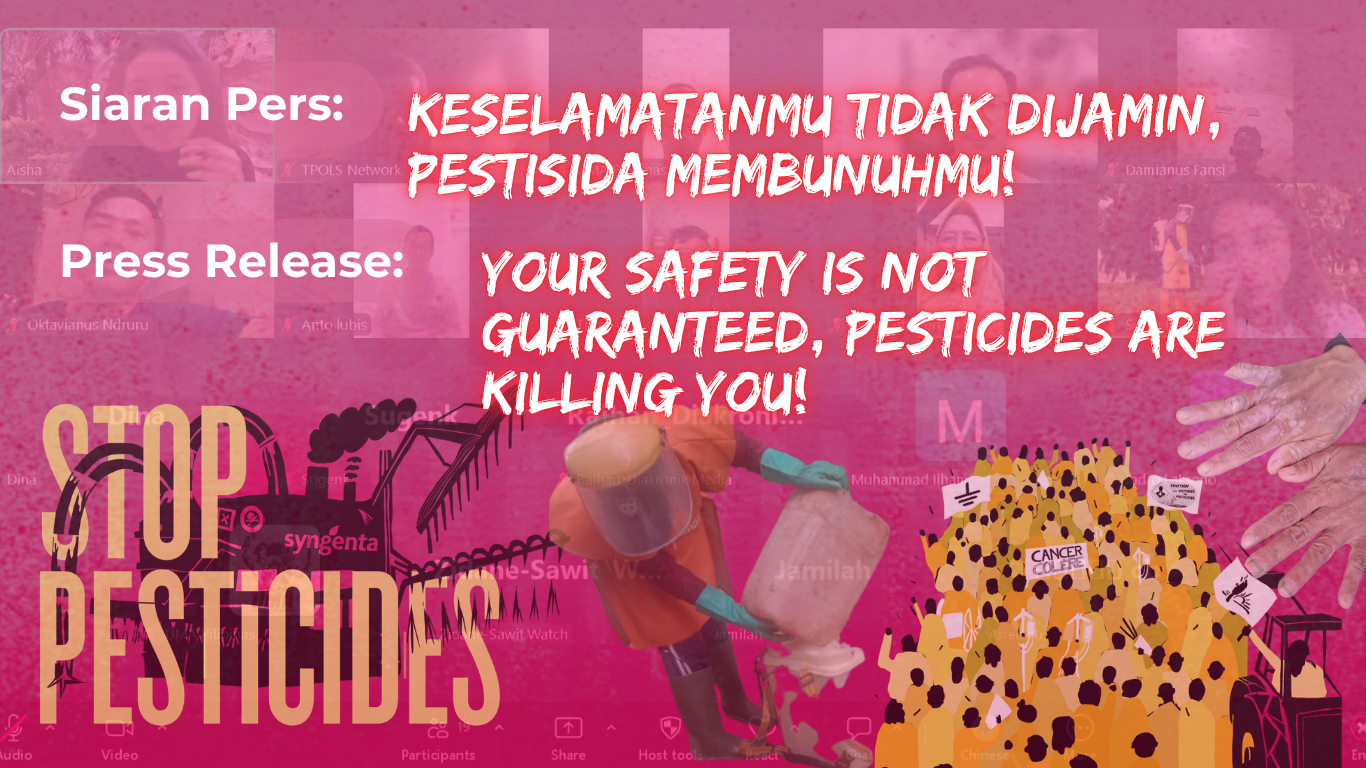
Bogor, October 3, 2026 – The monoculture plantation industry relies heavily on the use of agrochemicals, both pesticides and chemical fertilizers, to boost crop productivity. This is inseparable for massive profit accumulation by plantation giants. Consequently, highly toxic active chemicals such as paraquat, which threaten the health of plantation workers, continue to be produced by agrochemical companies and exported worldwide.
In response to this situation, the global resistance movement against the agrochemical industry mobilized actions and international campaigns in various countries—including France, Switzerland, Belgium, the United States, Costa Rica, Pakistan, and Indonesia—on October 2 and 3, 2026. This movement unites farmers, workers, and affected communities to demand an end to the production of highly toxic active chemicals that can kill those exposed to them.
For the past three years, the TPOLS Network has campaigned against the impacts of active chemical exposure borne by palm oil plantation workers. This specifically highlights female workers in the fertilizing and spraying divisions, who frequently come into direct contact with these chemicals. In conjunction with the global resistance movement, the TPOLS Network organized a public discussion titled “Pesticides Kill Us!” on October 2, 2026. During the discussion, at least two main points were highlighted by speakers and participants: (1) The obscuration of information regarding toxic active chemicals; and (2) The negligence of the state and companies regarding the occupational safety and health of plantation workers.
The Obscuration of Information Regarding Hazardous Active Chemicals
Pesticides and chemical fertilizers contain active ingredients notorious for their toxicity to humans, animals, and the environment. One of these is paraquat, which has been classified by the World Health Organization (WHO) as a Class II (moderately hazardous) active ingredient.
This chemical has been banned in over 70 countries, particularly in the European Union since 2007. Despite the ban, paraquat remains in use in Global South countries such as Indonesia. This active chemical is found in various commercial brands, including Gramoxone produced by Syngenta and Noxone by PT Multi Sarana Indotani.
“In tracking these substances, trade data only classifies commodities generally and does not specifically identify the active ingredients or their formulations. Information is fragmented across various institutions (producers, regulators, importers, distributors), making it very difficult to trace,” explained Sonia Buftheim, an independent researcher, during the online public discussion on Friday (02/10/26).
Information and knowledge regarding these hazardous active chemicals seem deliberately obscured. Tragically, Global North countries exploit this situation to reap profits through agrochemical trade, while Global South countries like Indonesia bear the health risks along with the resulting environmental damage.
“Northern countries shift their risks to Southern countries that lack sufficiently clear regulations and adequate knowledge,” Sonia Buftheim continued.
This disparity in knowledge results in workers’ ignorance regarding the types and impacts of exposure to the active chemicals they use.
“So, they don’t understand because they are never informed that if they don’t use Personal Protective Equipment (PPE), exposure to these chemicals will have certain impacts. It’s never been socialized,” explained Damianus Fansi, head of the United Workers Union (Serikat Buruh Makin Bersatu/SBMB).
Damianus also added that the brand of weed control pesticide or herbicide used on-site is not Gramoxone, but Prima Kuat, produced by PT Prima Karya Berjaya. Alarmingly, both of these brands contain the hazardous active ingredient paraquat.
“So, what I know for sure is that the one frequently used at our site is called Prima Kuat,” Damianus added.
It is not only workers who are exposed; communities surrounding the plantations are also massively exposed to pesticides without their knowledge. Gi Estrada from UMA Philippines explained in his presentation that pesticide spraying using mini-planes in Philippine banana plantations also has a widespread impact on surrounding communities.
Furthermore, health workers in Indonesia are often unable to link specific chemicals to the types of diseases suffered by exposed workers, whether at company clinics or public health centers (Puskesmas).
“So this is also a significant gap frequently found in the field. At several points, information can disappear, become fragmented, or even not be clearly visible at all,” Sonia concluded.
State and Corporate Negligence Regarding the Safety and Health of Plantation Workers
In practice, fair working systems, adequate PPE, health facilities, and sanitation facilities are never justly provided for palm oil workers. Workers in the field must struggle to meet high targets amidst difficult terrain and harsh weather, without adequate health guarantees.
“The quality of PPE provided by companies is inadequate. For example, safety goggles fog up when worn for a long time. As for other PPE, workers feel uncomfortable due to the terrain, such as areas with tall bushes,” said Damianus.
“The obstacle in the field is nature. When the wind direction suddenly reverses and hits the workers, the poison gets into their eyes and causes stinging,” revealed Asien.
A similar sentiment was shared by Jamilah, a sprayer from Serbukindo West Kalimantan. She recounted that pesticide use causes itchiness in the skin and throat.
“We use a yellow poison, but I don’t know what it is. It causes itching on the body and throat. If it touches your hands, it is sticky, and even washing it with water doesn’t remove it,” explained Jamilah.
Additionally, the lack of health facilities was highlighted by Jamilah. Currently, there are no health facilities available in the villages, making access to healthcare increasingly limited.
Similar complaints were voiced by Stella, a former sprayer and fertilizer worker from East Kalimantan. She mentioned that one of the factors accelerating exposure is the absence of rinse houses.
“One of the triggers for quick exposure happens during break times. There are no rinse houses, and we are far from clean water sources or handwashing stations. During breaks, our friends’ hands are contaminated with fertilizer residue. So the chemicals enter through the mouth, food, and drinks,” said Stella.
Although the impacts of poison exposure are not always immediately felt, chronic diseases can develop among workers in the long term. Anto Lubis from FSP-IPSI Riau stated that the effects of poison exposure are often only realized during retirement, with eye diseases, skin conditions, lung problems, and kidney failure becoming prevalent among both foremen and workers.
The provision of PPE, health facilities, and sanitation facilities are merely administrative controls that are ultimately ineffective. In an Occupational Health and Safety (OHS) management system, the most effective priority step for controlling chemical hazards is the elimination or cessation of the use of hazardous substances in the work environment.
“Actually, there are many regulations, but there is no implementation in the field. Perhaps almost no company is willing to protect its workers. It feels like we are basically being left to die on our own. So, I think we must stand in solidarity,” Sonia concluded.
Joint Demands of the TPOLS Network
Based on these findings, the Transnational Palm Oil Labour Solidarity (TPOLS) Network urges the Indonesian Government and companies to:
- Prioritize the protection of workers, especially female workers who are most affected by agrochemical exposure. Protection must include limiting targets and working hours without reducing wages.
- Mobilize all resources to ensure the fulfilment of the right to health, particularly access to proper and standardized health facilities, the availability of Occupational Doctors, and a comprehensive referral system.
- Strictly monitor (for the Indonesian Government) the distribution and use of agrochemicals, especially chemicals that have been banned under Regulation (EC) No.1107/2009. This includes taking strict enforcement action against companies that commit violations.
- Halt all efforts to expand palm oil land areas and production that result in widespread environmental damage due to hazardous chemical pollution.
- Ensure companies take responsibility for the health impacts of agrochemical exposure on workers, including providing health check-ups, medical treatment, recovery programs, and fair compensation for affected workers, without any intimidation or retaliation against those who report unsafe working conditions.
Contact:
TPOLS Secretariat: [email protected]
Download Press Release