


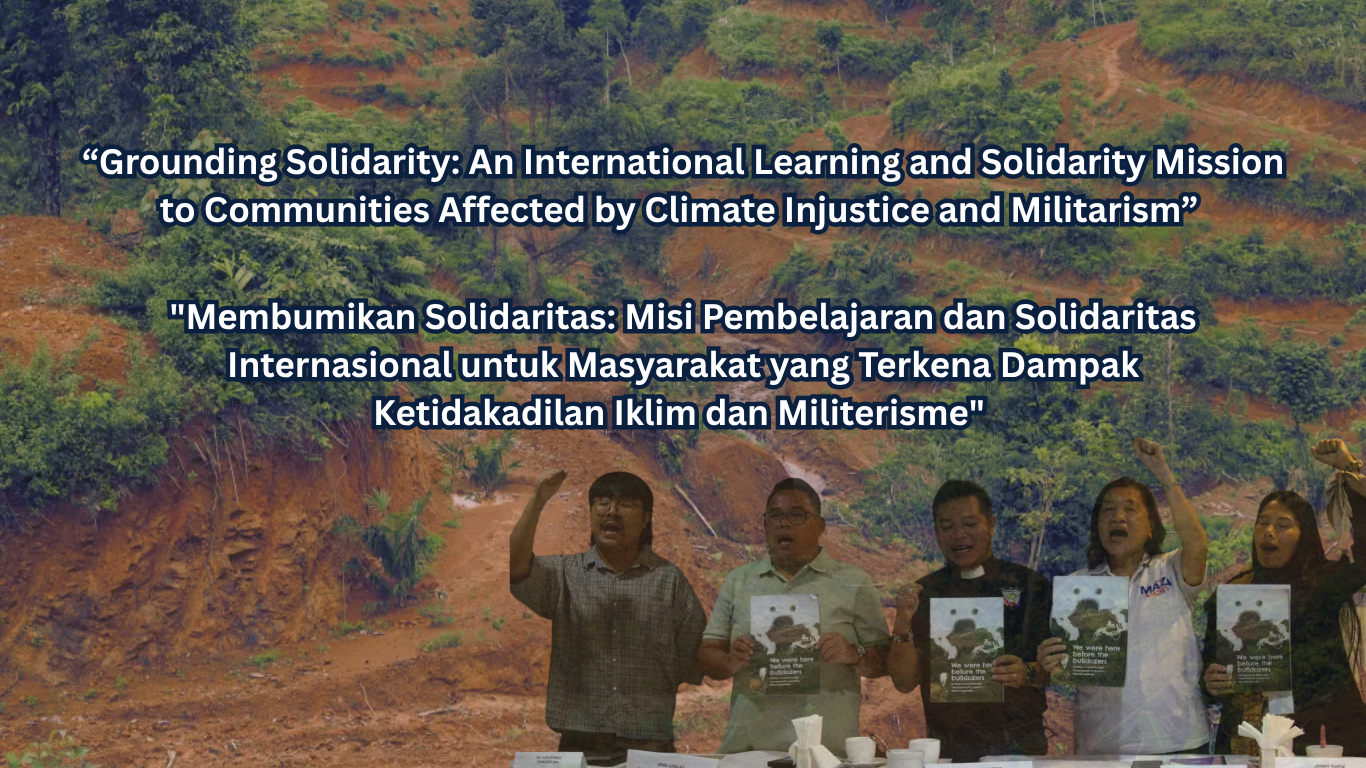
The Negros Island contingent of the International Learning and Solidarity Mission (ILSM) has urged the government to revoke the Integrated Forest Management Agreement (IFMA) granted to Hacienda Asia Plantations Inc. (HAPI) after documenting and confirming cases of human rights violations, labor exploitation, and environmental destruction linked to the Consunji-backed 6,652-hectare palm oil expansion in the town of Candoni.
The ILSM, held under the banner “Grounding Solidarity: An International Learning and Solidarity Mission to Communities Affected by Climate Injustice and Militarism,” was conducted from October 12 to 13 in Barangay Gatuslao. It forms part of a broader initiative with simultaneous missions in Rizal, Eastern Visayas, and Mindoro, where communities face displacement and repression linked to extractive and militarized projects.

“HAPI Inc.’s operations must be urgently ceased,” the ILSM said in its preliminary report presented in a press conference on October 14 in Bacolod City.
The mission found that HAPI Inc., despite lacking an Environmental Compliance Certificate (ECC), continued extensive earth-moving activities, including terracing, illegal quarrying, and deforestation. These actions led to severe soil erosion, the loss of native trees, and the destruction of habitats once home to wild boars, monitor lizards, iguanas, and endemic bird species.
“The damage caused by HAPI Inc. to the environment is irreparable,” said RJ Ledesma of environmental network HAKSON, Inc.

The adverse effects of HAPI’s operations extend to the community’s water systems. Rivers and creeks once used for drinking have turned muddy and polluted, with some waterways deliberately filled with soil and flattened to clear space for palm planting.
Delegates witnessed the state of Pagatban River, which locals said was once so clear “you could use it as a mirror.”
The river, once abundant with fish and vital to the community’s food supply, has turned brown and lifeless, with residents linking its decline to the use of fertilizers and chemical “foggers” in the plantation.
The ILSM also documented cases of labor exploitation among workers hired by HAPI. According to the report, employees are paid P480 daily for shifts extending up to 12 hours.
Workers receive no social benefits such as SSS, PhilHealth, or Pag-IBIG, and many endure unsafe and precarious working conditions. Senior workers recounted working under outdoor makeshift tents as hole-punchers for plastic pots used in palm seedling production, with a quota of 2,500 pots per day.
Seedling planters also face strict quotas, with those who fail to meet daily targets being reassigned to other jobs. All plantation work is conducted under heavy surveillance from drones or roving guards.
“As contractual laborers, these workers have no security of tenure,” the report noted. “The workforce has been steadily reduced from around 600 workers to roughly 150, comprising mostly office personnel and remaining laborers.”
Female workers face deeper precarity, with some reportedly dismissed as early as three months into pregnancy.
One worker recounted losing a finger in a tractor accident inside the plantation. The company allegedly provided no medical assistance, offering only P5,000 for treatment, barely enough to cover transportation and medicine costs.
“These accounts highlight the systemic exploitation and rights violations faced by workers at the HAPI oil palm plantation,” said Ariel Casilao of Unyon ng mga Manggagawa sa Agrikultura (UMA). “The lack of accountability and deliberate disregard for labor laws not only endangers worker welfare but also reflects a deeper pattern of corporate neglect and impunity.”
According to testimonies gathered, farmers reported that HAPI, with military and police assistance, bulldozed their sugarcane, corn, and pineapple crops. Others described drone surveillance and indiscriminate firing of weapons by the 15th and 47th Infantry Battalions of the Philippine Army.
“When locals refused to sell their properties, HAPI’s community relations officers would return with armed soldiers or police to intimidate them,” the report said.
Rev. Fr. Melvin Fajardo of the Iglesia Filipina Independiente and One Negros Ecumenical Council said the situation reflected “clear violations of the integrity of God’s creation.” He added, “Church people, and all sectors, must unite to end the destructive practices of HAPI.”
Jenny Rapiz of Alyansa nga Magbubukid ng Bulacan said the plantation has “destroyed the livelihoods of farmers,” adding that “from bulldozing their crops to military harassment, the farmers and IPs’ land rights are not being respected.”
Makabayan President Liza Maza said her group will file a House resolution to investigate the violations and the role of the Department of Environment and Natural Resources (DENR). “The call to revoke IFMA by the IPs is just,” she said. “The DENR shouldn’t have granted the IFMA because the said area is planted with agricultural crops.”
The ILSM recommended the filing of a writ of kalikasan against HAPI Inc., the rehabilitation of damaged lands, and the pullout of the 15th and 47th Infantry Battalions from the area. It also urged the Commission on Human Rights to investigate the use of state forces “in the service of HAPI Inc. and against poor peasants.”
Local governments, the mission said, should issue formal resolutions opposing HAPI’s operations and stand with their constituents in asserting land and environmental rights.
The ILSM also called for a legislative review of IFMAs and the Indigenous Peoples’ Rights Act (IPRA), warning that such policies are being weaponized to dispossess farmers and indigenous communities.
The groups reiterated support for the passage of the Genuine Agrarian Reform Bill (GARB).
“GARB should be passed,” the ILSM concluded, “as a new and thorough-going land reform program premised upon the tillers’ right to land, recognition of indigenous peoples’ rights, and food self-sufficiency.”