


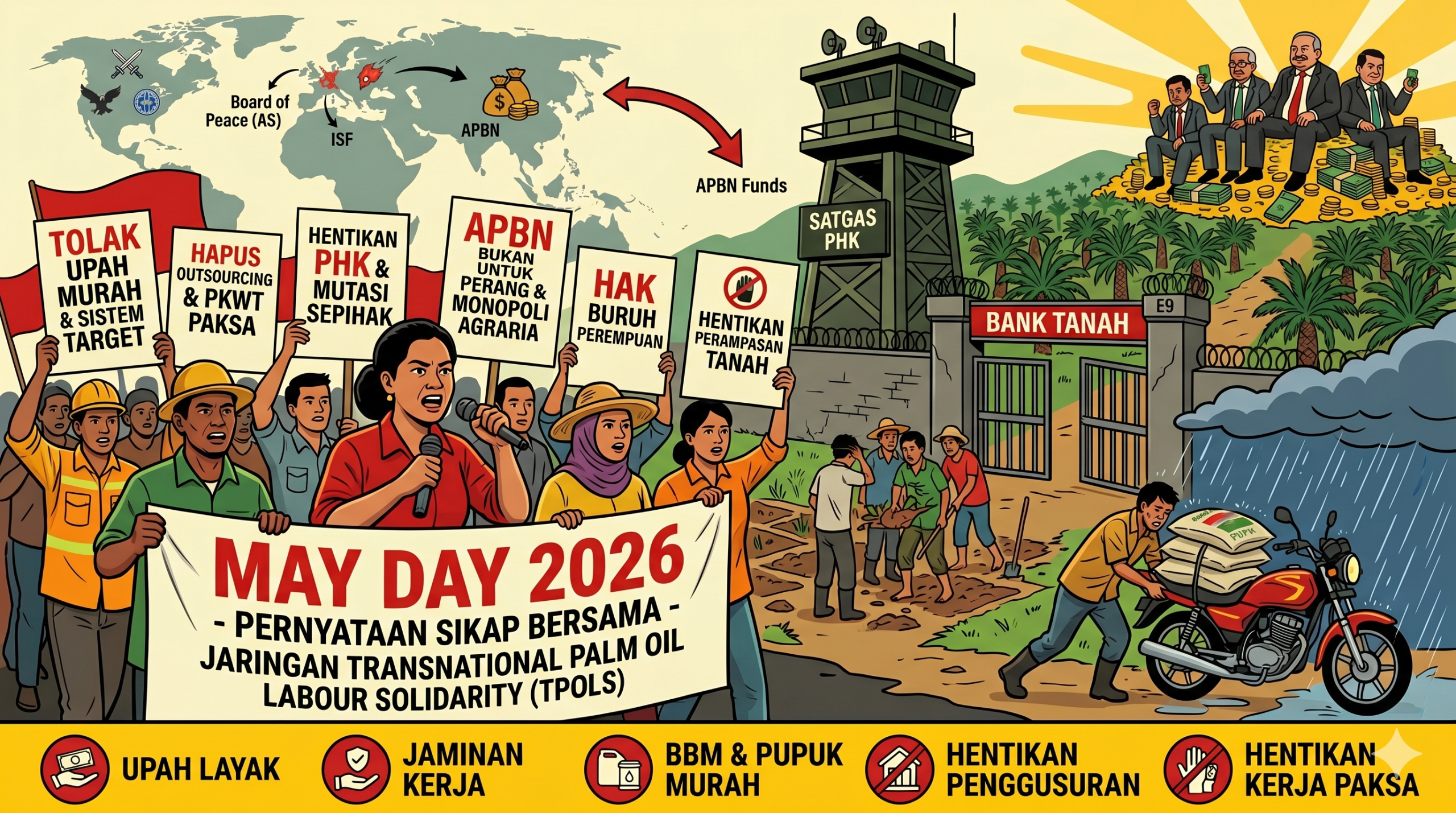
MAY DAY 2026: Collective Statement of Transnational Palm Oil Labour Solidarity (TPOLS) Network
THE NATIONAL BUDGET IS NOT FOR MILITARY EXPANSION, WAR FUNDING, OR AGRARIAN MONOPOLY
Since 2025, the TPOLS Network has strongly criticized the Indonesian government’s maneuvers to systematically expand and strengthen the military’s grip and oligarchic power within the civilian sphere. This penetration directly targets the heart of public affairs and the national strategic economy, particularly concerning agrarian governance, food supply, and oil palm plantations. These practices of militarizing and centralizing control over living spaces are blatantly legitimized by the state through several instruments and strategic projects, including: (1) The Forest Area Regulation Task Force (Satgas PKH), which transforms agrarian dispute resolutions into militaristic security operations; (2) PT Agrinas Palma Nusantara, which consolidates control over the palm oil supply chain through the seizure of millions of hectares of land under the influence of military entities; (3) The Land Bank Body (BBT), which seizes community lands and former HGU (Right to Cultivate) lands to facilitate large capitalists; (4) The New Rice Fields Creation Program (Food Estate), which normalizes the intervention of active military personnel in agricultural management; (5) The Merah Putih Cooperative, which instrumentalizes military territorial command structures (Kodim/Koramil) to intervene in agricultural supply chains at the local level.
The expansion of the military’s role is facilitated by (1) the massive disbursement of the National Budget (APBN) to finance these security-oriented projects and land monopolies and (2) regulatory engineering deliberately designed to grant extraordinary authority to military apparatuses and state corporations to meddle in and control civilian affairs.
These various militarization schemes have triggered alarm bells and become a primary focus for the TPOLS Network. Such practices not only legitimize the escalation of land grabbing but also exacerbate the vulnerabilities of laborers and farmers. Ironically, amidst the escalation of the US-Iran war, Indonesia is increasingly dragged into the vortex of international militarism by joining the US-led Board of Peace (BoP), and even accepting the position of Deputy Commander in the International Stabilization Force (ISF) in Gaza, accompanied by a commitment to deploy large numbers of troops. The deployment of thousands of troops abroad, the financing of military-oriented projects, and military arms procurement continue to drain the National Budget. Simultaneously, the domestic population bears the brunt of the domino effects from the US-Iran war, ranging from the depreciation of the Rupiah and soaring prices of basic commodities to fuel shortages and the loss of access to arable land. Instead of acting as a protector, the state consciously sacrifices the lower-class society, forcing them to bear the entire burden of economic risks resulting from the global crisis.
LAND GRABBING AND LABOR INFORMALIZATION (CASUAL DAILY WORKERS, FIXED-TERM CONTRACTS, AND OUTSOURCING)
During the TPOLS Network online discussion on April 24, 2026, participants raised issues demonstrating the close connection between labor informalization and the grabbing of community lands by the PKH Task Force, the Land Bank, and the New Rice Fields Creation (Food Estate) project. In Riau, the Task Force even seized lands, settlements, and school facilities belonging to indigenous communities. Along with the land grabbing and the loss of community livelihoods, discussion participants from various regions (Riau, Central Kalimantan, West Kalimantan) recounted a uniform pattern of communities being forced to become casual daily workers. Meanwhile, the vulnerability of workers within this outsourcing system continues to be deliberately maintained by the government.
- The Imposition of PKWT (Fixed-Term Employment Contract) and BHL (Casual Daily Worker) Status: In several plantations, the majority of workers are on PKWT or piece-rate status; in one plantation, roughly 85% of the workers hold PKWT and BHL status. This PKWT status is unilaterally forced by the company. “Our friends on the plantations are often forced to sign PKWTs. Some have even worked for up to 9 years. Those who refuse to sign the PKWT are sent home (unilaterally laid off),” stated a labor union official in Central Kalimantan. Furthermore, in many plantations, companies never provide a contract letter. After about 10 years of working, the company suddenly forced the workers to sign a PKWT contract.
- The Shift to Outsourcing/Vendor and Piece-Rate Systems: Many palm oil companies are leaning towards halting the recruitment of permanent workers. Companies prefer to use third parties (vendors) for worker recruitment or switch to a piece-rate system, even for core tasks such as harvesting, maintenance, and heavy equipment operation. Even permanent workers are persuaded to move to the outsourcing system with promises of higher wages. “Most of it is outsourcing there, recruited through a piece-rate system. After, for example, 6 months, it is extended again, and continually extended,” said a labor union official in Riau.
- Women Becoming Vulnerable Workers: As a result of land conversion and the loss of agrarian resources (including those caused by palm oil expansion and the Food Estate program), rural women are forced to become laborers on their own land. What initially started as a side job on palm oil plantations has now become their primary occupation. “These women themselves become contract workers, but without any clarity. The ones we are assisting have been working for almost 9 years, but they have never received their rights,” expressed a women’s solidarity activist in Central Kalimantan.
FORCED LABOR PRACTICES, LAYOFFS AND WORKER TRANSFERS, AND THE SUPPRESSION OF LABOR RIGHTS
Along with the massive informalization of labor in oil palm plantations, it is becoming increasingly easy for companies to commit violations and suppress workers’ rights:
- Forced Labor Practices: In various plantations, companies do not provide adequate operational vehicles or deliberately leave them in a state of disrepair. Workers are forced to transport production materials, such as fertilizers, using their own nearly broken-down motorcycles to meet production targets, even in bad weather or rain. This forced labor is also closely related to the loss of livelihoods and the implementation of the piece-rate system, which is accompanied by intimidation tactics involving layoffs and unilateral transfers.
- Wages Far Below Decent Living Standards & Oppressive Target Systems: Many palm oil companies apply target systems that oppress workers. In Central Kalimantan, loose fruit collectors (pengutip brondol) who were initially paid a daily wage (Rp 80,000/day) were switched to a target system where they are only paid Rp 350/kg with a mandatory total target of 90 kg/day. Ultimately, these workers only bring home around Rp 31,500/day, before deductions for gasoline, healthcare, and other expenses. “So eventually, many of those workers also quit that work system. They said they got nothing out of it,” stated an agrarian activist in Central Kalimantan.
- Suppression of Labor Rights: In one plantation, the company announced that pension funds had been abolished. “Several of our members have now reached retirement age; there are three fellow workers, but their pension funds are not being paid,” expressed a labor union official in Central Kalimantan. In addition, workers with outsourcing or piece-rate status do not receive the Holiday Allowance (THR) or the social security mandated by law.
- Layoffs (PHK) and Worker Transfers: In Central Kalimantan and Riau, land seizures by the PKH Task Force are often used as an excuse by companies to carry out mass layoffs or transfers under the pretext of efficiency or an oversupply of labor. Workers who dare to stage protests to demand their rights are highly vulnerable to being laid off or unilaterally transferred without cause. “The person we are assisting participated in a protest. Well, when she protested, she was actually transferred,” revealed a women’s solidarity activist in Central Kalimantan.
MAIN DEMANDS OF MAY DAY 2026
Based on the discussions and inputs within the TPOLS Network, we have formulated several main demands:
- Reject low wages and oppressive target systems.
- Implement decent wages and job security.
- Abolish the outsourcing work system and the forced imposition of PKWT status.
- Stop layoffs (PHK) and unilateral transfers.
- Stop forced labor practices and intimidation against workers.
- Implement the protection and fulfillment of women workers’ rights.
- Guarantee the availability of fuel (BBM) at low and affordable prices for the people.
- Lower taxes for the people.
- Guarantee the availability of cheap and affordable fertilizers for farmers, as well as ensure fair prices for agricultural products.
- Stop the eviction of people’s settlements for the expansion of oil palm and sugarcane plantations, industrial estates, and real estate.
- Stop the grabbing of people’s land under the guise of the PKH Task Force, the Land Bank, the Merah Putih Cooperative, the New Rice Fields Creation (Food Estate), or any other pretext.