


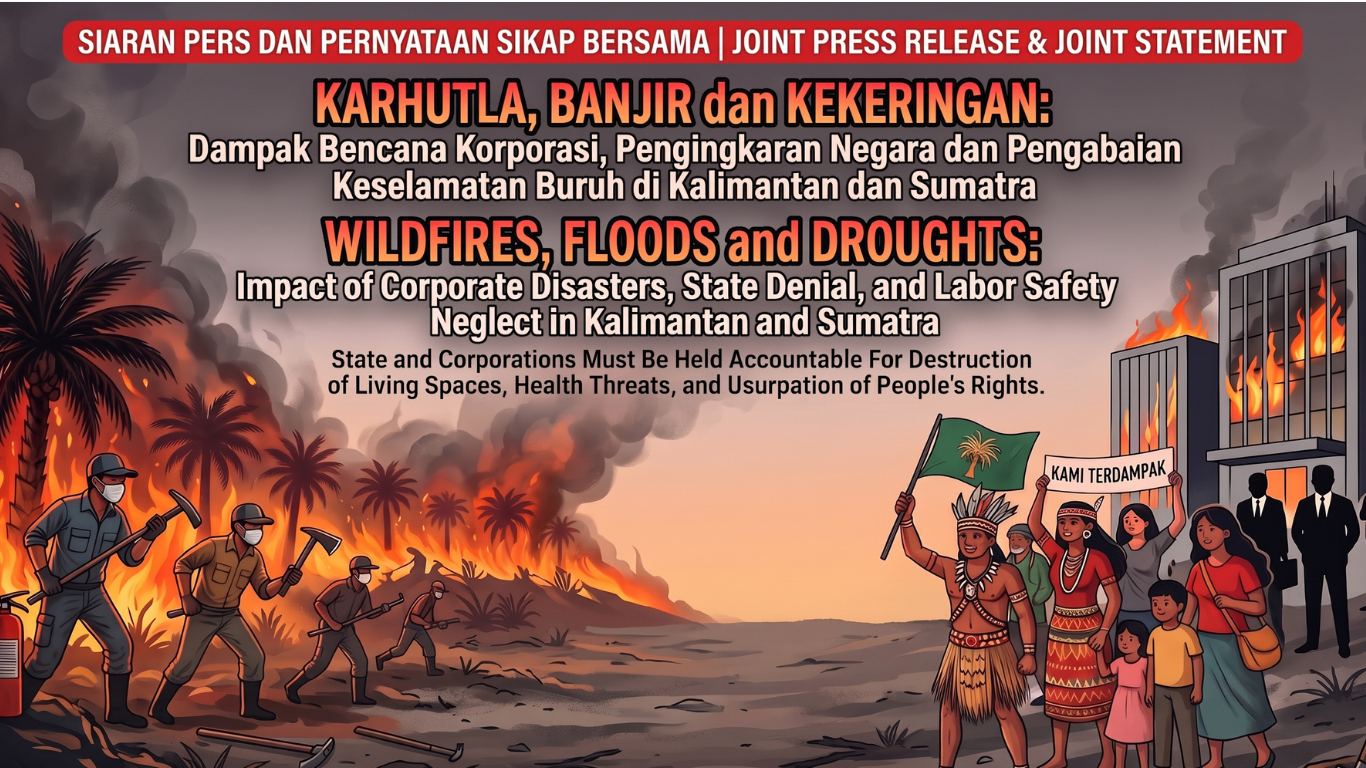
WILDFIRES, FLOODS, AND DROUGHTS:
Impacts of Corporate Crime, State Denial, and Labor Safety Neglect in Kalimantan and Sumatra
Bogor, September 2, 2026 – The wildfires that have once again struck several regions in Kalimantan and Sumatra are not merely seasonal natural disasters. The wildfires occurring in Indonesia constitute an ecological disaster linked to forest destruction, peatland drying, land-use changes, and the sporadic expansion of oil palm plantations carried out by the state and corporations.
“This recurring disaster must be reframed in its entirety to recognize that floods, landslides, forest and land fires, and the destruction of people’s living spaces are not merely the result of extreme weather phenomena and climate change alone,” said Rizal Assalam of the Transnational Palm Oil Labor Solidarity Network (TPOLS).
These disasters highlight the state’s failure to manage spatial planning and its weak oversight of corporate activities.
Research conducted by the Lokahita Foundation in collaboration with several civil society organizations shows that the area of oil palm plantations on the island of Sumatra has reached approximately 10.70 million hectares, exceeding the estimated ecological carrying capacity cap of 10.69 hectares. The study also found that approximately 5.97 million hectares of oil palm plantations are located in areas with ecological constraints.
This study assessed the upper limit (cap) for oil palm in Indonesia using the Environmental Carrying Capacity and Support Capacity (D3TLH) approach. The results indicate that Sumatra has reached an ecological deficit.
The most evident proof is the severe flooding in Aceh, which affected a landscape encompassing approximately 231,095.73 hectares of oil palm plantation concessions. In Mandailing Natal Regency, North Sumatra, the flood-affected area contains approximately 65,707.93 hectares of oil palm concessions, while in Pesisir Selatan, West Sumatra, flooding occurred in an area with similar concessions totaling about 24,004.33 hectares. When these three areas are combined, the total area of oil palm concessions located within landscapes severely affected by flooding reaches 320,807.98 hectares.
“Monoculture plantations and extractive industries have eliminated the ecological functions that should serve as water reservoirs and life-sustaining systems,” said Hotler Parsaoran of Sawit Watch.
Large-scale plantations reduce the ability of the soil and ecosystems to absorb water, increase surface runoff, while the risks of flooding, landslides, droughts, and fires are borne by the people. In addition to living under the shadow of disasters, local communities also face land grabs.
Thus, oil palm expansion is not merely a matter of investment and commodities whose profits are enjoyed solely by business owners and the state. This expansion has transformed people’s living spaces: eliminating access to land, damaging water sources, destroying forests, shrinking smallholder farming areas, and increasing vulnerability to ecological disasters.
According to data from the Ministry of Health, the forest and land fires in Kalimantan and Sumatra have already affected at least five million people. Approximately 13,500 of them required medical treatment for respiratory infections. This situation not only impacts people’s health but also results in the loss of homes and livelihoods, as the smallholder farms that sustain their lives have also been burned.
Ecological Disasters and the Neglect of Worker Safety
The impact of ecological disasters caused by forest and land fires is felt directly by workers on palm oil plantations in Kalimantan and Sumatra. This situation demonstrates that worker safety is still prioritized below production interests.
Palm oil plantation workers at several locations within the Transnational Palm Oil Labor Solidarity Network (TPOLS) have described their situation. Workers are still forced to go to work amid thick plumes of smoke that obstruct visibility to a distance of just five meters.
In another incident, twelve oil palm plantation workers in Palangka Raya, Central Kalimantan were trapped by fire and smoke before they were finally evacuated.
“The company only distributes thin masks—and even then, we only get four masks a week. And there are no restrictions on working hours; all workers are working as usual,” said Damianus Fansi, a plantation worker in Central Kalimantan.
In Central Kalimantan itself, there are still palm oil companies that continue to require their workers to labor without providing masks, vitamins, or medication. In addition, forest and land fires also impact women’s lives.
“Women are currently shouldering a heavier-than-usual burden of caregiving, compounded by a reduction in economic income due to forest and land fires that have burned agricultural land,” said Irene Natalia Lambung, Chair of BEK SP Mamut Menteng.
Women are forced to postpone tilling their fields and are struggling to meet their families’ economic and food needs. Furthermore, women’s psychological well-being is disrupted by anxiety that interferes with their sleep patterns and concerns for their families’ safety from the impact of subsequent fires. Forest animals entering residential areas also threaten livestock and the safety of children.
“All of this adds to the list of burdens women face during forest and land fires—burdens that have gone unseen and unaccounted for until now,” added Irene.
“The company has yet to take any follow-up action, particularly regarding assistance such as masks, clean water, oxygen, and medication,”said Kamil from FSPBR West Kalimantan.
Even as air quality deteriorates and the smoke poses a health hazard, the company has not halted outdoor work.
“The smoke makes it hard for us to breathe. Even as we struggle to breathe, we have trouble finding thick masks and still have to keep working,” said Agyl, a union leader in West Kalimantan.
In the midst of this ecological disaster, the company must immediately halt all indoor and outdoor production, carry out evacuations, provide health protection, and guarantee workers’ rights. A temporary suspension of operations is a necessary step, not merely an option.
The State and Corporations Must Take Responsibility
“Based on our analysis, the number of hotspots in recent forest and land fires has surged by 366 percent; this situation is strongly and inextricably linked to the escalation of national ambitions in strategic projects such as food estates and the push for biofuels (biofuel/biodiesel). Policies mandating increased energy production, which are not balanced by clean supply chain governance, have triggered brutal encroachment into new frontier areas—not Sumatra and Kalimantan, but Eastern Indonesia, such as South Papua. This positively correlates with the massive large-scale land-clearing projects taking place there,” said Achmad Surambo, Executive Director of Sawit Watch.
“Furthermore, we strongly condemn palm oil plantation companies that consistently sacrifice workers’ safety. Forest and land fires have a direct impact on palm oil workers who are on the front lines of the smoke. Companies should implement concrete emergency response policies, such as adjusting work hours, reducing daily targets, and prioritizing workers’ health and safety—not leaving them to work without adequate protection,” added Surambo.
In this regard, the government and companies are the primary actors who must take responsibility for this disaster.
The ecological disasters occurring today must not once again be resolved by scapegoating small farmers and the common people. Numerous news reports and monitoring by civil society organizations indicate corporate involvement in or contribution to these ecological disasters.
Amid the failures and slow response from the government and corporations, the people are building solidarity. Through communities, civil society organizations, and labor unions, aid centers are being set up for those affected. Donations are needed, such as masks, medicine, hand sanitizer, and oxygen.
People’s solidarity centers have been established at several locations, including:
West Kalimantan
- Pontianak:
- Sylvia Untan, Jl. Jendral Ahmad Yani, Gerbang Untan, Bansir Laut, kec. Pontianak Tenggara, Kota Pontianak, Kalimantan Barat.
- LinkAR Borneo, Jl. Raya Desa Kapur, Komplek Villa Duta Residence No. 8 B (Kubu Raya). Donations can be made through Bank BNI: 1278584912 of Erni Damayanti (Staff Link-Ar Borneo). Contact person: Widya (0831-0100-6522)
- Konfederasi Persatuan Buruh Indonesia (KPBI): Donations for wildfire victims. Donations can be sent to Bank Rakyat Indonesia (Bank BRI) 207401000614563 of KPBI (Konfederasi Persatuan Buruh Indonesia), Person in Charge: Lula, KPBI Kalbar (+62-896-0900-4570) and Elza, DEN KPBI (+62-856-5658-9028)
- Singkawang:
-
- KPBI Kalbar. Jl. Senen, Gg Tanfirdaus, RT 006 RW 002, No 55 Kel. Sungai Rasau, Kec, Singkawang Utara, Kota Singkawang. Narahubung : KPBI Kalbar (+ 62 822-1052-5848).
- Sambas:
-
- FSPBR. Bengkel Mitra Otomotif, Jl. Kartiasa Kc. Sambas Kabupaten Sambas. Contact Person: Firmansyah (+ 62 853-9213-8796)
Central Kalimantan
- Koalisi RAKAT. Jl. Beliang No. 184, Palangkaraya, Jekan Raya, Kota Palangka Raya, Kalimantan Tengah. Cash disbursements can be made through Bank BNI : 8134712510 of JPIC Kalimantan. Contact Person: Agung (+62 852-8183-8201) dan Irene (+ 62 813-4756-071).
North Kalimantan
- GSBI and KASBI North Kalimantan Humanitarian Aid Center. . The relief centers are located in Tanjung Selor and Tanah Kuning. Cash donations can be made via Bank Mandiri account number 1490013787975 of Eddy Aspiansyah. Regional Coordinators for Tanjung Selor and Surrounding Areas:: Halidin (+62-813-5188-7399); Yudho (+62-851-9417-0468); Nanang (+62-822-5373-1344); Eddy (+62-813-4667-0223). Coordinators for Tanah Kuning and Surrounding Areas: Sulaiman (+62-823-3522-2229); Kahar (+62-812-1853-8407).
This solidarity is a form of mutual support among the people. People’s solidarity must not be used as an excuse for the state and corporations to shirk their responsibilities. The state and corporations bear the primary responsibility for addressing and recovering from ecological disasters.
In light of this situation, we, the Transnational Palm Oil Labor Solidarity (TPOLS) network, demand:
- Stop the expansion of oil palm plantations and end impunity for corporations that destroy the environment and seize people’s land.
- Declare the forest and land fires (Karhutla) and the series of disasters in Aceh, North Sumatra, and Kalimantan as National Disasters.
- Guarantee the safety and rights of workers.
- Prosecute officials who have failed to anticipate the series of ecological disasters in Indonesia.
- Urge the central government to compile gender-disaggregated data on those affected by the forest and land fires.
- Restore the rights of communities affected by forest and land fires in Kalimantan, Sumatra, and Eastern Indonesia.
- Immediately take priority actions to restore environmental damage, including the restoration of peatlands.
Contact:
TPOLS Secretariat: [email protected]