


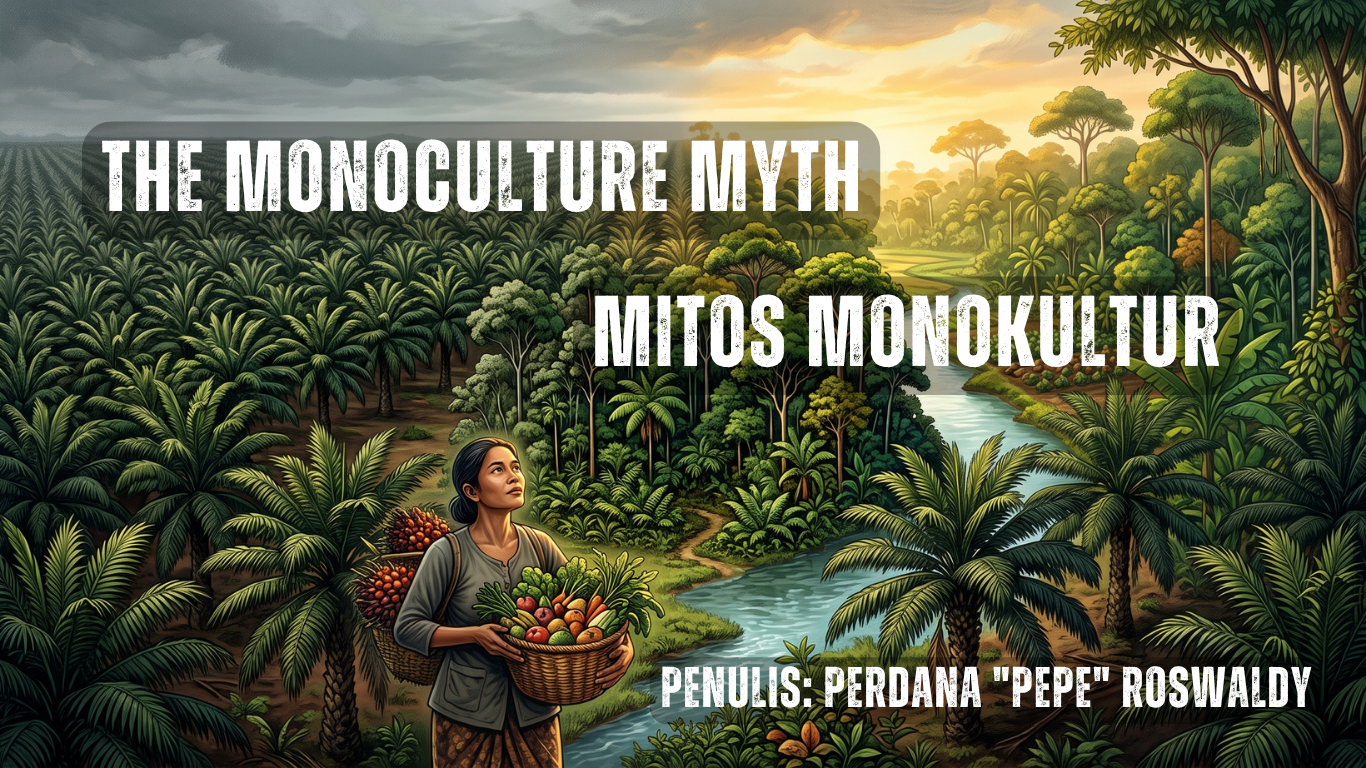
What would our future look like when our presence is rooted in monoculture? What would climate governance look like under the supremacy of monoculture?
Indonesians, from commoners, bureaucrats, elites, to even those who are afflicted by monocrop economy have this putative understanding that plantation is necessity, plantation is development. Plantation is assumed – the actors who assume so are a very interesting set of social and political classes – the beacon of modernity coming to Indonesia’s godforsaken rurals. Plantations or monocrops have been here, not coincidentally since Dutch colonialism. Unlike in certain parts of the world, plantations are alive, not only a historical ruin and legacy, but an active agent that shapes our course of economic and development, with no foreseeable future in which they cease to exist.
However, that putative or normalization of plantations as a mode of development and growth is not natural in the sense that it is not simply given. It’s historically molded; plantations are among colonial fictions; a legal and socio-economic reengineering of nature and its people. The historical transformation of plantations is never less than colossal. Even during its ancient Rome time, the term plantere specifically prescribed the expansion of large estate at the dismissal of small farmers, or vast numbers of land to plant specific high value crops and the use of indentured if not slave labor. Historian Ferdinand Braudel in his Wheel of Commerce writes that plantations are a capitalist invention par excellence, especially during its proliferation in the colonial times. It is no less than an institutional marvel because only few entities such as plantations that could embody and signify the legal dictum of ninth-tenth of the law, where possession and properties are constantly reinvented to create durable assets, remold certain subjects, and a legal ecosystem of wealth defense to support the power of capital and contemporary landed gentries in many forms – oligarchs and even state elites.
Plantations have transformed, metamorphose, from more than just a business asset to an ideology, defined by Clifford Geertz as maps of social realities and matrices of collective consciousness. When plantations become an ideology, it’s less so much about a false belief in the power of plantation economy and the socio-political structures that sustain it, but the prescription of legal systems that favor rentiership and proprietorship as the basis of social relations for their constituents.
Plantations, irrespective where they are – so this is very much a commonality, are a state and a space of exception. Once an area is institutionalized as a plantation, the territorialization conducts a specific political and psychic regime to adhere to land dispossession, the dismissal of rural lives, and any alternatives to reimagine our relationship and governance with and of nature especially under the pressure of climate change. For example, Indonesia – and not just Indonesia – is so adamant about making palm oil as the spearhead of sustainability with B50 fuel. We laugh when the president said that oil palm is a tree, but that statement is 1) not new (the debate has started since 2015); 2) signified the legal reengineering and reclassification of entities in and of plantations to support and rebuild the plantation political economic ecosystem.
Every nook of plantations is assetized and thingified, to borrow the term from the great anticolonial thinker, Aime Cesaire. Humans, soil, even the stamp of sustainability become a commodity and it’s not a simple story of making bankable or marketable values out of something. Making commodity is only the beginning of the long exhaustive process of exploitation. Through the making of commodities, value being extracted and produced from these plantation inhabitants is taken as magically inherent. The expansion of plantations assumes an easy money making machine. Aside from whether it’s true, one should still ask: what makes plantations easy? What drives their efficiency? In Indonesian context, is it inherently efficient or the fact that the whole efficiency is built upon legal fictions that establish erfpacht that metamorph and metastasize to foreign capital law in the aftermath of the 1965 massacre? Or even in the widely hailed Basic Agrarian Law that supposedly protects us from expansive privatization of land, but ends up enabling a predatory collusion between the state, the oligarchs, and the thugs? Is it because of the broken back of workers who must carry hundreds of kilograms of fresh fruit bunches everyday following the legal restructuring of our financial capital that requires atomization of workers? Is it because of the constitution that consistently disincentivizes, if not outwardly disavows indigeneity and their social relation with land?
I want us to think about what kind of justice that we can have under the rampant and increasingly distressing effects of climate change/environmental crises. Could there be any climate justice if our approaches towards this, another magical tool called “climate adaptation” mirror the plantation lives, one that according anthropologists Tania Li & Pujo Semedi, a life that is under corporate occupation and governance negligence? More problematically, sometimes the ideology and the “justice” of plantations are upheld from the below. Plantations are not only locking plantations as an institution, it’s spatially locking people and legally binding people into this state of exception. In my dissertation, I call this plantation Imaginarium, in which people simply, often helplessly, could not overcome the power and the standing of plantations. Not only are they unable to overcome their dependence on the monoculture economy, they force plantations to work in order to make sense of these failures and injustice; their aspirations for economic welfare and political prowess hinges upon the idyllicity of plantation crops.
We often see this joke from people that, what do you want to be when you grow up? Oh, having palm oil plots. I want to just sit down and receive monthly payments from palm oil. Easy lives that have no reality basis in plantations, a myth that is shared and upheld by everyone, but most particularly the state officials.
Yet, environmental crises in monoculture are also a catalyst for change from below. Plantation workers and indigenous farmers everywhere, despite and in spite of their limitations whether in resources or political imaginations, have constantly reminded us that we should not accept a life that requires us to work ourselves to death just to get billions of dollars before we can even get the bare minimum of decency. They reject this idea that in order to be powerful, you need million hectares of palm oil plantations; a clear refusal against plantation ideology and an invitation to rethink about how we should produce our food, food sovereignty, environmental justice, and how we consume. Workers and indigenous farmers share the same vision for ecological justice, that wage is not the only reason worth living and organizing. In that sense, the contradiction of living off plantation economy is transformed into a realization that everyone deserves clean water, a life free from agrochemical intoxication that drives workers and farmers to their deaths.
Perdana “Pepe” Roswaldy
Assistant Professor in Master of Sustainability program at Monash University, Indonesia