


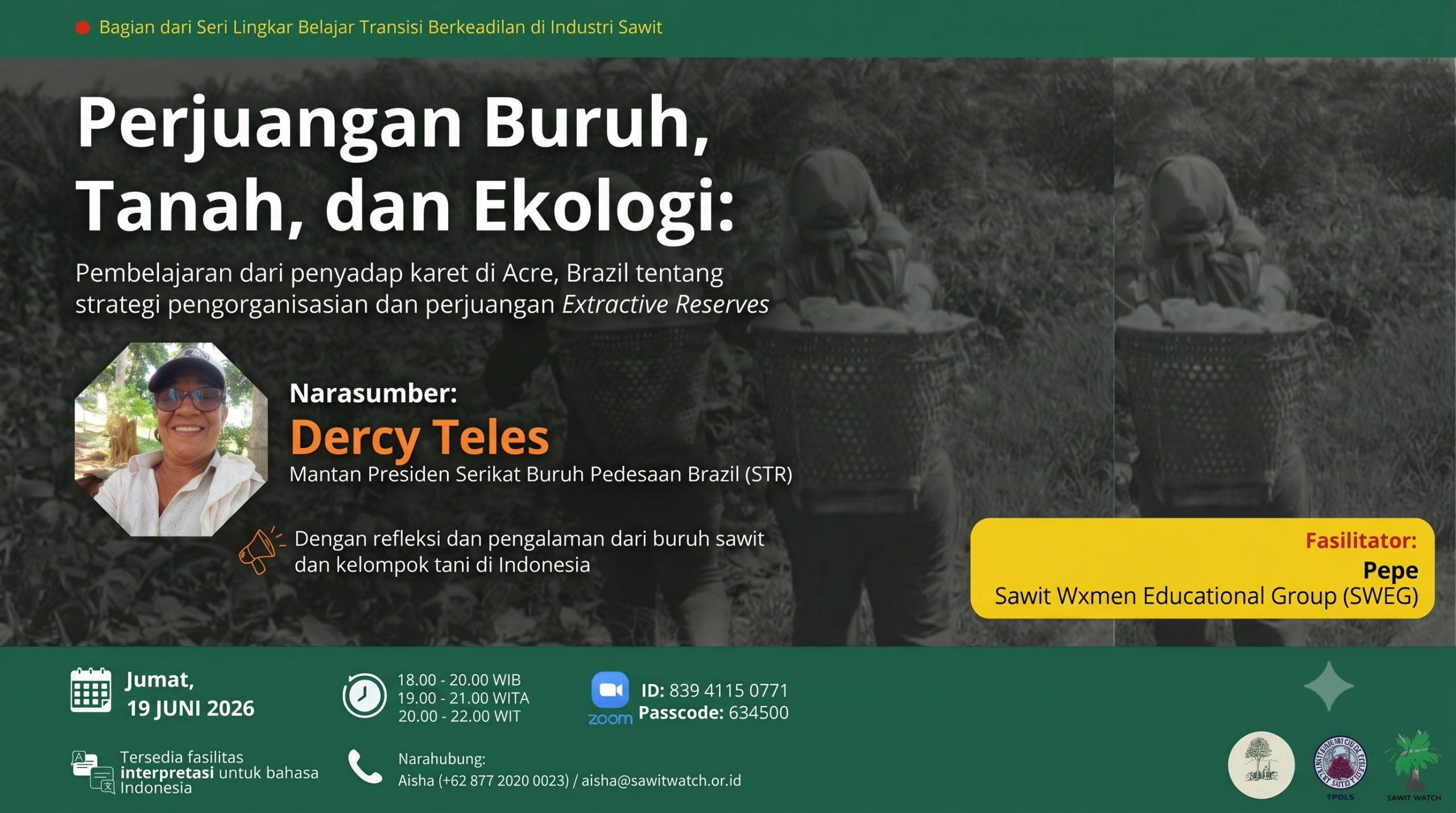
Friday, June 19, 2026 — An online discussion titled “Labor, Land, and Ecology Struggle: Organizing Strategies and the Struggle of Extractive Reserves in Acre, Brazil” was held through a collaboration between Sawit Wxmen Educational Group (SWEG), Sawit Watch (SW), Transnational Palm Oil Labour Solidarity (TPOLS), and World Rainforest Movement (WRM). The discussion was facilitated by Pepe from SWEG and featured Dercy Teles, former President of the Brazilian Rural Workers’ Union (STR), as the speaker. This discussion is part of the “Just Transition in the Palm Oil Industry Learning Circle Series,” which aims to reflect on the experiences of rural workers’ unions in Brazil in relation to the conditions of peasant groups and palm oil workers in Indonesia. This article is a brief note on the lessons learned from the struggle of the Rural Workers’ Union in Brazil.
The Beginning of the Conflict and the Formation of the Rural Workers’ Union
In the early 1970s, the Xapuri region underwent a drastic change, shifting from an extractive system (harvesting forest products, especially rubber) to a cattle ranching area. This change was made unilaterally by the bosses or owners of rubber plantations at the time, who sold forest land to ranchers. The main problem with this transaction was the ignorance of the rubber tappers and their families, who had long settled deep in the forest. The landowners arrived with hired thugs (jagunços), used violence, evicted the workers’ families, and burned their homes. This panic triggered a massive exodus from the deep forest to escape and seek a livelihood on the outskirts of the city. As a result, cities suddenly became extremely overcrowded, and slums emerged.
Boosting Union Meetings Through Church-Based Communities
Faced with an oppressive system, the community began looking for ways to fight back. In 1978, the Catholic Church helped organize the community through “Evangelization Groups,” bringing a Liberation Theology approach, which taught that faith must liberate humans from social oppression. After the religious sessions ended, the meetings immediately continued with a joint reflection on problems led by union delegates. It was here that they proposed and designed strategies to strengthen resistance against state policies that had turned their lives in the forest into a “hell.”
Identifying Daily Problems and Implementing Concrete Actions
In 1978, the community chose Dercy as the driving force behind the Evangelization Group and as a union delegate. Through a series of meetings, Dercy and her colleagues successfully identified three main problems on the ground:
- Severe Illiteracy: The literacy rate was very low, with the majority of the community unable to read or write. This condition was far more concerning among women.
- Lack of Health Access: The absence of medical facilities or basic first aid services deep in the forest.
- Economic Exploitation: After breaking free from the control of plantation bosses (landlords), the community found themselves trapped by marreteiros (middlemen). These middlemen arrived on horses or donkeys to buy the people’s rubber at rock-bottom prices, then sold necessities back to them at exorbitant rates.
This struggle took place under the shadow of Brazil’s military dictatorship regime. Dercy noted that at every community meeting, undercover police officers would infiltrate to record and photograph the faces of participants, which was later used to intimidate and persecute the people. Despite being closely monitored by the military, in 1981, this community began running various independent programs in a guerrilla-style manner, including:
- Overcoming Illiteracy as a Survival Strategy: They pioneered a literacy program for youth and adults. While serving as President of the Xapuri Workers’ Union, Dercy inaugurated the first school deep in the forest, where access was extremely difficult—requiring a 12-hour walk. This reading and writing education was not just a regular learning process, but a survival strategy. Amidst the tapping of radio channels by the Federal Police, the ability to read and write allowed the community to communicate safely through letters and secret messages undetected by intelligence.
- Forming Community Cooperatives: To break the chain of exploitation by the marreteiros, the community discussed developing economic independence. This was realized through the formation of a cooperative system so that people could manage buying and selling activities collectively and fairly.
- Empowering Community Medical Personnel: Through pressure from the labor union, the State Health Secretariat was eventually forced to recognize the existence of village medical personnel. These medics were trained directly by a nurse with a doctorate from the Universidade Federal do Acre. They were not only equipped with conventional first aid skills but also trained to produce homeopathic medicines utilizing the forest biodiversity around them.
- Breaking Male Dominance (Machismo): Dercy succeeded in tearing down the wall of gender discrimination by being elected as the first woman to serve as President of a Rural Workers’ Union in Brazil. Previously, labor unions were exclusive spaces for men, and the only women allowed to join were widows. Interestingly, in the following term, the union’s executive structure was 90% female.
- Formulating Extractive Reserves (Reserva Extrativista): The classrooms held in the middle of the forest also functioned as arenas for political debate. As a result, the class participants grew into “opinion leaders” who were literate about their rights. It was this political awareness that spearheaded the people’s resistance in halting the pace of deforestation. The peak of this long struggle was their success in formulating and realizing the “Chico Mendes Extractive Reserve”—a protected forest area covering nearly one million hectares. This protected area was born directly from the ideas of the forest working class, with the basic principle that they are the ones who have the most right to decide their way of life and methods for managing the forest area sustainably, not outsiders.
Mobilization, Alliances, and Advocacy
- Building Forest Community Alliances: A strong alliance was built between indigenous peoples (native people) and non-indigenous communities (rubber tappers). Both were united by the same interest: defending the forest as their main source of life, both for food supplies and for tapping rubber sap. This solidarity was manifested through various joint meetings aimed at exerting political pressure on the government.
- Mass Action Mobilization(Mutirão): The community used mass gathering strategies to descend upon centers of power, such as the Governor’s Office, the Legislative Assembly, and INCRA. In practice, a small committee was sent in to negotiate, while a large mass stood guard outside as a show of force. This unity and mass pressure were highly feared by the government and local authorities.
- Direct Confrontation Actions(Empates): Besides negotiation, the community also took the path of confrontation, namely resistance actions in the form of demonstrations or direct blockades in the field. One crucial moment occurred on May 2, 1982, through the first major encounter in Xapuri, which led to the arrest of 112 people (men and women) by the police.
- Tactical Role of Union Leaders: Based on directives from CONTAG (Confederation of Agricultural Workers), the Union President was prohibited from going directly to the sites of confrontation. This tactic was implemented to avoid government accusations that mass actions were driven by a single provocateur—an anticipatory step taken following the tragic murder of the Brasileia Union President. Instead, union leaders were tasked with staying at headquarters to organize legal protection strategies (preparing lawyers) and provide food logistics for the arrested members.
- Garnering Support and Expanding Networks: This struggle was not fought alone. Their movement was supported by city merchants who voluntarily donated food for hundreds of demonstrators. Furthermore, they also successfully garnered broad solidarity and secured grant funding (fundo perdido) from various networks at the national and international levels.
- National Advocacy for Community-Version Extractive Reserves: In 1985, the Labor Union held a National Meeting of Rubber Tappers in Brasília. This meeting aimed to advocate for the concept of extractive reserves that they had formulated together, while also urging the Federal Government to make the “Chico Mendes Extractive Reserve” a reference model for community-based agrarian reform. This demand was ultimately only realized by the government after Chico Mendes was assassinated.
The Decline of the Movement Due to State Intervention and Party Politics
Closing her explanation on a bitter note, Dercy revealed that various past successes are now experiencing a fatal decline due to various interventions from the state. This decline is reflected in the following aspects:
- Cooptation of Labor Unions and Fragmentation of Civil Society: There is a strong irony; if during the military dictatorship, severe pressure actually sparked solid unity to reclaim rights, in the current democratic era, the community’s struggle has weakened. Civil society organizations have been fractured because they were infiltrated by partisan political interests brought in by government structures. Consequently, the original function of the “Chico Mendes Extractive Reserve” is now threatened, and dialogue with the government often stalls at the “discussion table” as mere bureaucratic lip service without any concrete action.
- Standardization of Community Education: The government has taken over forest community schools and standardized them with urban schools. This policy effectively killed the space for critical political debate that had been the soul of their local education system.
- Shifting the Role of Health Agents: The function of Health Agents was altered by the government so that their programs and services are no longer relevant to the specific needs of the communities living in forest areas.
- Militarization Under the Guise of Environmental Conservation: The government demobilized civil society and simultaneously militarized the protected areas. Law enforcement officers and environmental protection agencies—such as ICMBio, IBAMA, and Força Nacional—were deployed to restrict the movement of people.
- The Illusion of Infrastructure Development: The presence of modern infrastructure in the “Chico Mendes Extractive Reserve” (such as dirt roads and electricity networks) was, in reality, built not for the welfare of local people. These facilities purely serve the interests of capitalist extraction, especially for logging transport routes and cattle ranching. Furthermore, these deforestation activities drive away the game animals that have been the main food source for the local population.
- Lack of Economic Alternatives: People are forced to turn to the livestock sector simply to survive. This happened due to the collapse of the rubber market and the absence of government policies supporting the utilization of forest products by the people. The people’s economic choices are severely limited, leaving only one nut cooperative monopolized by the state and one private company as a rubber buyer.
- Covert Eviction: There is a ban on people practicing subsistence farming (farming to meet their own food needs). Because the government only demands absolute forest preservation without providing solutions or economic alternatives for the people, this policy is tantamount to a “covert eviction.” Slowly but surely, this condition will force people to leave because they no longer have a way to survive on their own land.
“Muito embora hoje a realidade, com o enfraquecimento da organização da sociedade civil causada pela interferência da política partidária, essa reserva tenha uma outra função e inclusive tá ameaçada, mas teve um papel fundamental enquanto produto de uma organização da classe trabalhadora da floresta, que era quem decidia a forma de lidar e de conviver na floresta. Depois que o Estado assumiu, aí deu uma outra conotação pro processo que hoje está fracassado, porque não existe mais o fortalecimento; a organização da sociedade civil foi fragmentada com as intervenções político-partidárias do Estado.”
“Today, the reality is that the Reserva Extrativista has changed its function and is under threat, along with the weakening of civil society’s power due to the interference of party politics. In fact, this area previously played a very crucial role as a tangible manifestation of the forest workers’ movement, who autonomously determined how they managed and lived alongside the forest. Since the State took over control, the direction of the movement has changed and has now failed. There is no longer any strengthening from below; the power of civil society has been scattered by partisan political intervention from the State.”
Happy Learning and Fighting!