


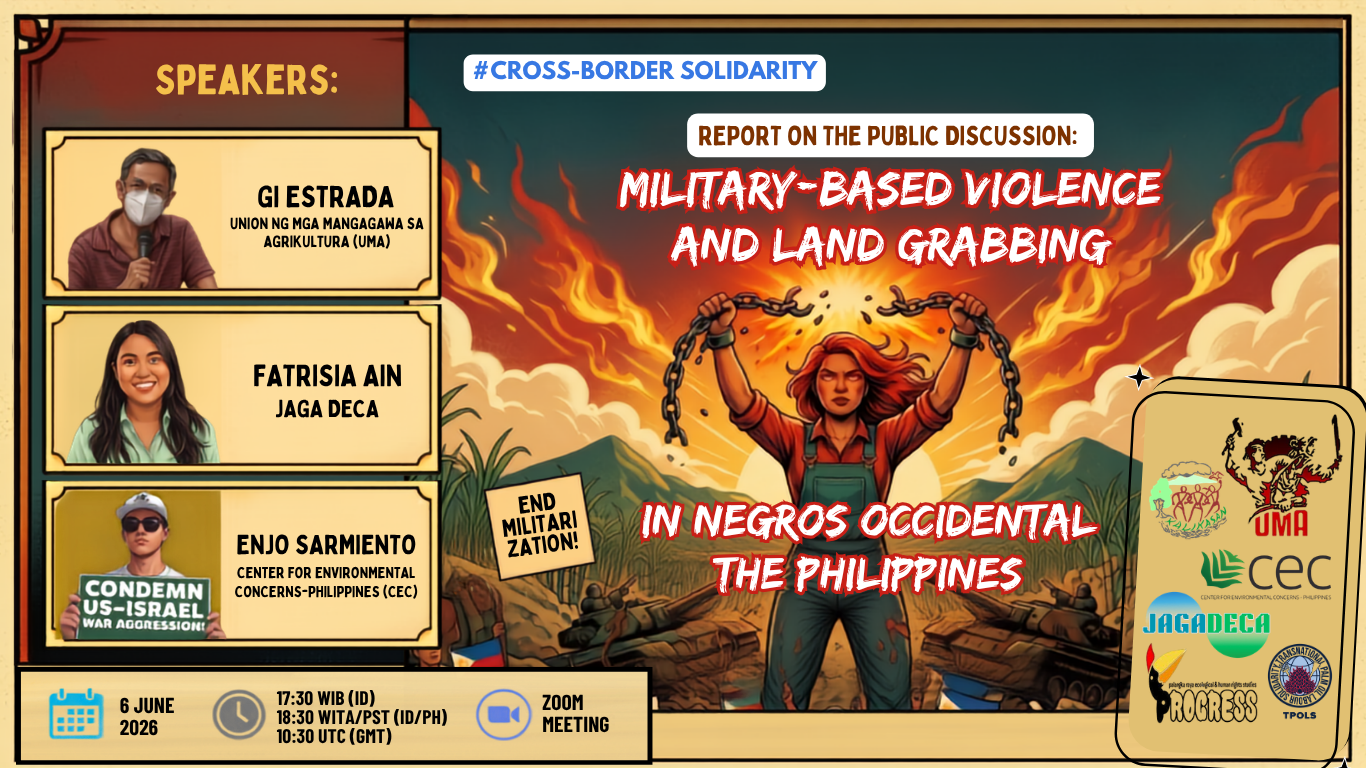
Saturday, June 6, 2026 — The increasingly widespread military-based violence and land grabbing in the Southeast Asian region have sparked deep concern among various civil society groups. In response to this crisis, an online public discussion titled “Military-Based Violence and Land Grabbing in Negros Occidental, The Philippines” was held to build cross-border solidarity. The discussion was facilitated by Kartika from Palangka Raya Ecological and Human Rights Studies (PROGRESS), featuring three speakers: Gi Estrada from Unyon ng mga Manggagawa sa Agrikultura (UMA), Fatrisia Ain from JAGA DECA, and Enjo Sarmiento from the Center for Environmental Concerns (CEC).
Gi Estrada (UMA) explained the history of land expansion and monopoly, labor exploitation, and the series of humanitarian tragedies in Negros. Historically known as the sugarcane granary of the Philippines, Negros Island remains trapped in a colonial legacy of hacienda-style feudal and semi-feudal exploitation. The agrarian reform program (CARP), implemented since the Corazon Aquino era, has been a structural failure; over 100,000 hectares of land were left undistributed, and 80% of the distributed land was forcefully leased back to landlords because the beneficiary farmers lacked capital. This situation was exacerbated by the World Bank’s SPEED program, which converted collective land titles into individual ones, making it easier for the land to be sold. Furthermore, the government facilitated the grabbing of public land through the expansion of a 6,000-hectare palm oil plantation by a large corporation (DMCI/Happy Inc.) in Candoni. As a form of resistance, farmers initiated independent land occupations and cultivation campaigns (Bungkalan) covering up to 5,000 hectares, which the state is currently attempting to dismantle.
This structural inequality has created slavery-like conditions for 350,000 sugarcane farmworkers in Negros. Approximately 97% of laborers work under a group piece-rate system (Pakyaw), where dozens of people are forced to work 8–12 hours a day (even loading sugarcane at night due to extreme heat) for a shared wage of 400–500 pesos per ton of sugarcane. Meanwhile, only 3% receive a daily wage (480 pesos—well below the minimum standard). This suffering peaks during the tiempo muerto (dead season), which can last up to six months, forcing workers into debt with landlords simply to survive.
The agrarian crisis is further aggravated by the massive conversion of agricultural lands by the local government into solar farms, mining sites, and tourist areas, as well as policies allowing foreign land lease extensions of up to 99 years. The citizens’ resistance is deeply rooted. In response to this resistance, the state deployed 7 to 9 infantry battalions, creating a de facto state of martial law in rural Negros. The military engages in red-tagging—baselessly accusing labor unions like the NFSW of being communist fronts—and replicates “Tokhang”-style killings (similar to the 2019 Oplan Sauron, which claimed the lives of dozens of farmers in just a few days). Violations of International Humanitarian Law (IHL) have occurred through extrajudicial killings of captured or wounded combatants.
With 8 victims of enforced disappearances and 113 political prisoners, the international community is urged to speak out, submit petitions to government agencies, and mobilize cross-border moral and material support to halt the militarization in Negros. This escalating conflict culminated in the Toboso Tragedy on April 19, 2026. In this incident, the military killed 19 people; nine of them were non-combatant civilians, including minors, UMA staff member Erol Wendell, and UP Diliman student Alisa Alano, who bled to death after being denied medical access.
Enjo Sarmiento (Center for Environmental Concerns – CEC) explained the roots of the conflict, environmental destruction, and militarization in Negros. Following the massacre of 19 people in Toboso, state-run media immediately labeled all victims as rebels (terrorists), even though they simultaneously admitted that they did not yet know the victims’ identities. This is a state tactic to discredit those fighting for agrarian reform and indigenous peoples’ rights in Negros.
Although Negros is the fourth-largest island in the Philippines, exceptionally rich in biodiversity and part of the Coral Triangle, its people are left impoverished due to historical exploitation: (1) The practice of land monopoly by an elite few (hacenderos) initiated by the Spanish was not abolished by the American colonizers; instead, it was reinforced to facilitate the extraction of natural resources, particularly sugarcane. (2) The collapse of the global sugar market in the 1980s, worsened by the corruption of the Marcos Sr. regime and soil degradation from monoculture farming systems, triggered a severe famine that lasted for five years. (3) The agrarian reform program (CARP) from the Corazon Aquino era to the current Marcos Jr. regime has proven to be a failure. The people of Negros are even facing massive displacement in the name of development. There are various destructive projects displacing fishing communities and indigenous peoples (Ati/Ata), ranging from attempts to revive massive mines (Maricalum and Basay), the $480 million Hinoba-an open-pit copper mining project, dozens of offshore mining permits, land reclamation in Bacolod, to a tunnel project cutting through the mountains. The Marcos Jr. government declared Negros the renewable energy (RE) capital by granting fast-tracked approval lanes and tax breaks. However, these projects are monopolized by private companies and the same energy oligarchs through public-private partnership (PPP) schemes, bringing absolutely no economic benefits to local communities.
The state uses military instruments to facilitate the grabbing of citizens’ living spaces. The Global Witness Report (2024) ranked the Philippines as the deadliest country in Asia for environmental defenders, where the military (AFP) is the main perpetrator of abductions and killings. The deployment of military troops has been proven to consistently overlap with mega-project locations. Their presence aims to crush the opposition and resistance of local citizens, not to conduct counter-insurgency as the government always claims. On one hand, the military claims that Negros is already “insurgency-free” and safe. Yet, on the other hand, Memorandum Order No. 32, a legacy of the Duterte regime—which legalizes the deployment of additional military battalions in Negros—is still maintained and enforced by the Marcos Jr. regime. As long as these conditions of structural oppression, land grabbing, and environmental destruction are maintained, the people of Negros will continue their resistance to demand a more just economic, political, and social system.
Fatrisia (Jaga Deca) explained that the tragedy of the killing of 19 civilians in Toboso, Negros Occidental, is not merely a local tragedy in the Philippines, but rather a reflection of systemic issues in Southeast Asia. This incident proves how legitimate demands for land rights, livelihoods, and social justice are responded to by the state using a “security” lens (securitization) rather than democratic solutions. When a security approach replaces justice, civic space shrinks, and the risk of lethal violence against civilians sharply increases.
Militarization in this region is closely tied to the geopolitical rivalry between the United States and China. The Balikatan joint military exercises in the Philippines are a symbol of US military expansion aimed at maintaining its influence in the Indo-Pacific. This puts Southeast Asia in danger, as it risks becoming a battleground for superpowers (the “Global North”). This practice of militarization redefines the concept of security solely from the state’s perspective—not the people’s—so that agrarian conflicts and demands for basic rights are viewed as national security threats.
Indonesia faces the same pattern of structural oppression as the Philippines. As a major supplier of palm oil, nickel, and global strategic minerals, Global South countries like Indonesia (including communities in Central Sulawesi) are forced to act merely as extraction sites, sources of cheap labor, and consumer markets. To smooth the way for National Strategic Projects (PSN), downstreaming policies, and the energy transition, investment stability is made an absolute priority. As a result, the resistance of citizens defending their living spaces is consistently met with stigmatization, criminalization, and repression by armed state forces. The line between “national security” and “investment security” becomes blurred.
In Indonesia, militarization is not only seen in armed conflicts but also manifests through military involvement in civil, economic, and development affairs. This is evidenced by the military’s entry into the civil government and food security programs, as well as the current regime’s plan to establish hundreds of new battalions. The deployment of these additional troops goes hand-in-hand with policies that clear millions of hectares of customary forests in Sulawesi, Papua, and Kalimantan for large-scale plantation mega-projects (Food Estates) under the guise of energy transition and food self-sufficiency.
At the end of the discussion, the speakers and participants agreed to emphasize the importance of international solidarity and unity in confronting state repression and rejecting the grabbing of living spaces. Gi (UMA) and Enjo (CEC) appreciated the network’s consistency in mutually strengthening the struggle and fighting black propaganda, specifically regarding the campaign demanding justice for the 19 people from Negros. In line with this view, Fatrisia (Jaga Deca) emphasized the importance of cross-border unity to reject the expropriation of living spaces for the interests of the state and big capitalists, while highlighting the urgency of future solidarity for Papua, which is threatened by massive militarization for the regime’s strategic projects.
Summarizing the shared patterns of oppression in the Philippines and Indonesia, Rizal (TPOLS) asserted that justice cannot be realized through litigation alone; rather, it must be seized through organized collective power. According to him, true transformation can only be achieved when workers, peasants, and oppressed communities unite and build strong alliances. Kartika (Progress) closed the discussion with an invitation to continue nurturing spaces of collective resistance, and proclaimed, “Long live international solidarity!”.
To follow the complete discussion, please watch the YouTube video at this link:
CROSS-BORDER SOLIDARITY: JUSTICE FOR NEGROS 19or read the discussion transcript at this link:
Transcript of the Public Discussion